


Compare DataDome and Akamai Bot Manager against the traffic, applications, and customer actions you need to protect. If the requirements include mobile and API coverage, account protection, cross-session analysis, AI-agent controls, DDoS services, predictable failure handling, and transparent total cost, neither product is complete.
DataDome adds cost through higher tiers, event volume, SDKs, and a separate Account Protect integration. Akamai adds complexity through Premier, additional security products, mobile SDK work, and unpublished pricing. Without mapping those requirements first, teams may overpay for features they do not need while still missing coverage around accounts, transactions, or infrastructure failures.
Before signing a contract, require both vendors to list every product and integration included in the quote. Confirm which traffic requires an SDK, how your team can investigate and reverse a false positive, whether protected actions fail open or closed during an outage, and whether each product can follow suspicious activity beyond the first request into account and transaction events.
Key Takeaways#
- DataDome Bot Protect starts at $3,830 per month. Mobile and M2M coverage begins on Advanced, MCP protection starts on Premium, and Enterprise begins at $13,270 per month.
- DataDome Account Protect is separate from Bot Protect, requires its own SDK and API key, and is not enabled by default. DataDome's documentation says Account Protect allows the action when its API times out or returns an error.
- Akamai reserves behavioral detection on transactional endpoints for Bot Manager Premier. Native mobile protection uses an Akamai SDK, while account-lifecycle analysis requires Account Protector.
- DataDome adds event-based cost, integration maintenance, SDK work, and separate account coverage. Akamai adds product selection, tuning, vendor dependence, and pricing that remains opaque until the full scope is quoted.
- DataDome Bot Protect uses a client-identifier cookie, device fingerprinting, and browser and behavioral telemetry. Akamai Bot Manager also uses security cookies, browser fingerprints, network data, and interaction signals.
- hCaptcha Enterprise combines bot and AI-agent policy with Account Defense, Fraud Protection, User Journeys, Private Learning, and configurable responses. It operates independently of the CDN and supports Zero PII deployments through no-cookie operation, IP blinding, pre-blinded fields, and blinded identifiers.
DataDome vs Akamai Bot Manager at a Glance#
| Category | DataDome | Akamai Bot Manager |
|---|---|---|
| Primary scope | Bot and agent protection with web, mobile, API, and MCP coverage gated by plan; Account Protect is separate. | Edge bot detection; Premier adds transactional behavioral scoring, Account Protector adds lifecycle risk, and Content Protector and App & API Protector cover other scopes. |
| AI / LLM crawler angle | Agentic Trust provides policy controls; it depends on the Bot Protect integration and selected plan. | Verified and custom bot categories sit in Bot Manager; Content Protector adds advanced scraping controls. Product ownership should be confirmed in the quote. |
| Account protection | Account Protect is separate, disabled by default, and requires an SDK, dedicated API key, and application handling of its recommendation. | Account Protector is a separate product that adds account-lifecycle analysis. |
| Privacy and data handling | Uses the datadome client-identifier cookie, device fingerprinting, and browser and behavioral signals; the cookie lifetime can be configured from seven days to one year. | Uses security cookies, browser fingerprinting, network and device data, session identifiers, and interaction telemetry. |
| Operational burden | Server- and client-side integration, event forecasting, mobile SDKs, Account Protect SDK work, tuning, and false-positive review. | Product scoping, Premier configuration, mobile SDK work, tuning, exceptions, and probable vendor assistance. |
| Failure behavior | Decision APIs and integrations require an explicit fallback; Account Protect allows activity by default on timeout or error. | Bot, account, API, DDoS, managed service, and support dependencies can remain within one vendor relationship. |
| Pricing | Essentials $3,830/mo; Enterprise starts at $13,270/mo | No Bot Manager rate card on Akamai's public product pages; contact sales |
| Main limitation | High starting price, event-based cost growth, tier-gated coverage, SDK and integration work, client-identifier cookie use, device fingerprinting, and no volumetric DDoS protection. | No public pricing, Premier-only behavioral detection, separate products, SDK work, tuning, and broader vendor concentration. |
DataDome product scope, tier gates, and operating cost#
DataDome Bot Protect uses cookies and classifies application-layer traffic using device, network, browser, IP, and behavioral signals. DataDome also offers session protection and Agentic Trust, but the entry plan does not include its full enterprise scope.
Essentials begins at $3,830 per month. Mobile apps and M2M APIs require Advanced, MCP protection starts on Premium, and custom models and Premium SOC access move the deployment into Enterprise. Account Protect is separate from Bot Protect, must be enabled through an account manager, and requires a dedicated API key and backend SDK integration.
A full deployment can require a server-side integration, browser tag, mobile SDK, Account Protect SDK, endpoint configuration, tuning, and event forecasting. DataDome protects Layer 7 traffic but does not replace volumetric network DDoS protection.
A pilot should measure false positives by traffic type, time to explain and reverse a block, SDK maintenance, event volume, vendor assistance, and the cost of every additional product.
Akamai Bot Manager: product scope and operating cost#
Akamai Bot Manager uses cookies and scores automated traffic at Akamai's edge, mapping those scores to responses. Behavioral detection on transactional endpoints requires Premier, while native mobile protection uses Akamai's dedicated SDK.
Other requirements move into the wider Akamai portfolio. Account Protector includes Bot Manager capabilities and adds risk analysis across account creation, login, recovery, and later account activity. Content Protector addresses advanced scraping, App & API Protector covers another part of the application stack, and Prolexic handles network-level DDoS protection.
Akamai publishes no Bot Manager rate card that connects those products. The quote must identify the edition, traffic allowance, overage terms, SDK work, support, managed services, and every additional product.
The quote only captures a piece of Akamai's cost. The internal team still has to create policies and exceptions, investigate disputed decisions, and tune the system as traffic changes. Ask the pilot team to explain a disputed decision, reverse an incorrect block, and identify which changes require Akamai assistance.
Detection, false positives, and deployment work#
DataDome reports that Bot Protect evaluates requests in under two milliseconds. Treat that figure as vendor-reported and measure the complete path, including server-side calls, browser tags, mobile SDKs, challenges, and Account Protect recommendations.
Akamai uses Bot Score and related detections to drive policy. Account Protector adds user-risk signals, but Bot Manager still requires score bands, response rules, exceptions, and tuning for the traffic in scope.
Test corporate networks, VPNs, privacy-focused browsers, partner APIs, mobile releases, monitoring systems, and unusual customer behavior. Use independent reviews to identify likely trouble spots, then test both products on false positives, missed abuse, decision evidence, exception time, analyst work, and rollback speed.
DataDome can integrate with several CDNs and server environments, but infrastructure independence does not remove integration work. Akamai's edge deployment can simplify one architecture while adding migration and vendor-dependency costs when the rest of the stack is elsewhere.
Web, mobile, API, and MCP protection#
Coverage depends on the purchased plan and integration. DataDome Essentials covers websites and web APIs. Advanced adds mobile apps, mobile APIs, and M2M APIs; Premium adds MCP protection. Mobile deployment requires SDK installation and release maintenance.
Akamai applies Premier behavioral scoring to registered transactional endpoints such as login, signup, checkout, and add-to-cart. Native mobile requests require its dedicated SDK. API, account, application-security, and DDoS requirements can bring additional Akamai products into the deployment.
Test every non-browser client before enforcement. A browser challenge or JavaScript signal may not fit native apps, service-to-service APIs, payment providers, monitoring systems, or partner automation.
Account takeover and transaction fraud#
DataDome Account Protect is separate from Bot Protect. It requires a dedicated API key and backend SDK, and the application must act on DataDome's recommendation for login, registration, password changes, profile updates, and other supported events. Timeouts and errors return an allow result by default, preserving availability while potentially admitting abuse during a failure.
Akamai Account Protector includes Bot Manager capabilities and adds lifecycle analysis. Buyers should confirm which account events are protected, how user identifiers are handled, and whether the quote includes the API and application-security products needed around those flows.
Test signup, login, recovery, new-device activity, profile changes, checkout, payment attempts, and post-login actions as one progression. hCaptcha Account Defense, Fraud Protection, and User Journeys can connect those events with blinded identifiers instead of using a raw customer identity as the linking key.
AI agents and automated access#
DataDome's Agentic Trust is documented to go beyond crawler classification. Its controls depend on traffic reaching the Bot Protect integration, and deeper MCP coverage is gated by plan.
Akamai can recognize verified bots and customer-defined categories through Bot Manager. Content Protector adds stronger scraping defenses, while account and application actions can involve Account Protector or other Akamai products. The quote should show which product owns each policy.
Agent identity is only one part of the decision. Security teams also need to decide whether an agent may create an account, recover credentials, call an API, modify a profile, or complete a payment.
hCaptcha Enterprise can apply Rules Engine policies to a named agent, agent traffic as a category, and the risk of the requested action. Its distinction is the combination of agent policy with cross-session account and transaction context, Zero PII options, and independence from the CDN.
Privacy and data handling#
DataDome Bot Protect uses the datadome cookie to identify a client and preserve session context. Its JavaScript tag and challenge pages need read and write access, with a configurable lifetime from seven days to one year. Public website cookie disclosures list DataDome's security cookie with a one-year lifetime. The tag also collects browser, operating-system, GPU, device, and behavioral signals, including mouse movements or keystroke patterns.
DataDome states that Device Check does not collect personal information, but the feature still inspects technical hardware and environment details and uses client and device fingerprinting. Account Protect can receive account identifiers, session data, addresses, phone numbers, email values, IP data, and customer-defined fields, depending on the implementation.
Akamai Bot Manager uses security cookies, browser fingerprinting, IP and network data, browser settings, session identifiers, and behavioral telemetry. Public website cookie disclosures list Akamai's _abck security cookie with a 364-day lifetime. Review the browser state and data generated by each script and SDK, processing locations, retention periods, and any raw account or transaction identifiers sent to Akamai.
hCaptcha Enterprise supports a different deployment model. Zero PII configurations can use no-cookie operation, IP blinding, pre-blinded fields, and blinded identifiers, reducing the raw personal data exposed to the security provider while preserving bot, account, and transaction-risk context.
Pricing and total cost of ownership#
DataDome publishes list prices, while Akamai does not publish a Bot Manager rate card. Published pricing gives DataDome greater initial visibility, but it does not show the cost of every product, event, integration, service, or traffic spike.
DataDome's current published tiers list:
| Plan | Price | What it adds |
|---|---|---|
| Essentials | $3,830/mo | Websites and web APIs, under 100M requests/month |
| Advanced | $8,670/mo | Mobile apps, mobile APIs, and M2M APIs |
| Premium | $10,160/mo | MCP protection, named support/AM teams, SLAs, SSO, audit trails |
| Enterprise | From $13,270/mo | Customizable AI models, advanced rate limiting, Premium SOC access, and >300M requests/month |
Public pricing lists Essentials at $3,830/month and Advanced at $8,670/month. Moving to Advanced adds $58,080 to the annual subscription, before Account Protect and other separately quoted products. Add mobile and API requests, Account Protect events, MCP endpoints, overages, SDK support, managed services, and other products to the budget. Account Protect needs its own price alongside Bot Protect.
With event-based pricing, architecture matters. hCaptcha Enterprise's architecture can be up to 40x more efficient in event consumption.
For Akamai, require a quote that names Standard or Premier, Account Protector, Content Protector, App & API Protector, Prolexic, mobile coverage, support, managed services, traffic allowances, and policy assistance.
Compare both configurations on prevented loss, legitimate-user impact, implementation work, analyst time, exception handling, vendor assistance, and total operating cost. A published starting price and a bot score do not establish the value of the production deployment.
Compare production outcomes#
Use the products, plans, integrations, and services named in the final quote. Test normal browsers, corporate VPNs, privacy-focused devices, native apps, partner APIs, payment providers, monitoring systems, residential proxies, and approved automation before introducing attacks.
Then test distributed login attempts, account recovery abuse, profile changes, AI-agent activity, card testing, checkout abuse, and a decision-service failure.
Record what the platform observed, why it reached the decision, what action followed, whether a legitimate user was interrupted, how long an exception took, how much analyst or vendor work followed, and whether the attack caused confirmed loss.
Where hCaptcha Enterprise has an edge#
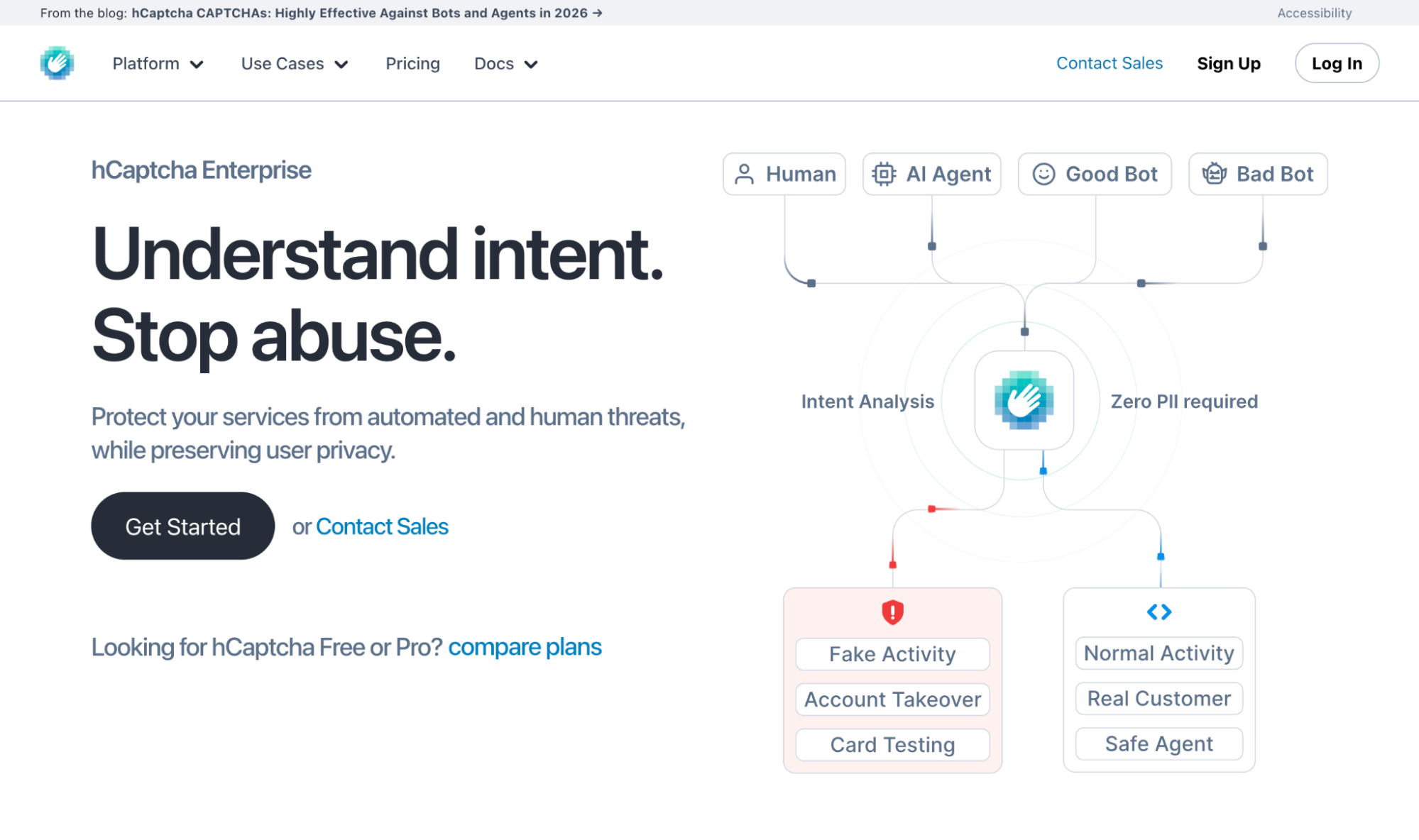
DataDome offers Bot Protect, Agentic Trust, real-time session protection, and a separate Account Protect product. Akamai adds account-lifecycle analysis, scraper defenses, API security, and DDoS coverage through other products. hCaptcha Enterprise brings bot, agent, account, and transaction risk into one platform without depending on the CDN.
At the traffic layer, hCaptcha Enterprise combines Bot Detection with User Journeys. Blinded identifiers can connect activity across websites, apps, APIs, sessions, devices, accounts, and transactions without making the raw customer identity the linking key.
For AI traffic, Agent Controls identifies agents, supports Web Bot Auth verification of signed-request provenance, and shows their activity across a session. A verified signature does not grant access by itself. The organization can allow low-risk automation, require verification before a protected action, or deny automation where its policy prohibits it.
The Rules Engine can apply those decisions to a particular agent, a category of agent traffic, or an account or transaction action. Responses can include verification, step-up authentication, rate limits, or blocking.
Account Defense extends the analysis through login, recovery, and post-login activity, while Fraud Protection adds transaction risk. MFA supplies step-up verification when the action requires more assurance.
Private Learning adds customer-specific models using pre-blinded data. Zero PII deployments can also use no-cookie operation, IP blinding, pre-blinded fields, and blinded identifiers. Because hCaptcha operates independently of the CDN, an organization can retain its existing edge and volumetric DDoS providers while keeping bot, agent, account, and fraud decisions on a separate path.
Compare the three finished configurations on false positives, missed abuse, prevented loss, privacy exposure, agent-policy control, recovery behavior, staff effort, and total cost.
What this means for an enterprise buyer#
DataDome's main drawbacks are its high starting price, event-based cost growth, plan-gated mobile and MCP coverage, separate Account Protect integration, device fingerprinting, SDK work, and continued tuning.
Akamai's main drawbacks are unpublished pricing, Premier-only behavioral detection, a dedicated mobile SDK, multiple product boundaries, tuning requirements, and the number of security functions that can remain tied to one vendor relationship.
hCaptcha Enterprise is the recommended specialist platform when the priorities include bot and AI-agent policy, cross-session account and transaction risk, customer-defined responses, Private Learning, Zero PII deployment options, or independence from the CDN provider. The decision should follow measured security outcomes and total operating cost.
Frequently Asked Questions#
Is DataDome better than Akamai Bot Manager?
DataDome operates across several infrastructure environments and publishes plan prices, but its entry price is high and mobile, MCP, account, and support requirements expand the plan or product scope. Akamai Bot Manager runs at Akamai's edge, but Premier, Account Protector, mobile SDK work, API security, DDoS services, and tuning can expand the final deployment. Compare both complete configurations with hCaptcha Enterprise on security outcomes, privacy, operating effort, and total cost.
What are the main disadvantages of DataDome?
DataDome starts at $3,830 per month, charges Bot Protect by request volume and Account Protect by event volume, and places mobile, M2M, MCP, custom-model, and support capabilities in higher plans. Account Protect is separate and requires another SDK and API key. Device fingerprinting raises privacy questions, while integration maintenance, false-positive review, and the lack of volumetric DDoS protection add operating work.
What are the main disadvantages of Akamai Bot Manager?
Akamai publishes no Bot Manager rate card. Behavioral detection on transactional endpoints requires Premier, native mobile coverage uses an Akamai SDK, and account-lifecycle analysis requires Account Protector. API security, advanced scraping, DDoS services, policy tuning, and vendor assistance can further increase cost and configuration complexity.
How do DataDome, Akamai, and hCaptcha Enterprise cover APIs and mobile apps?
DataDome gates mobile apps and M2M APIs behind Advanced and uses native SDKs. Akamai protects mobile traffic through its dedicated SDK, while broader API scope can require other Akamai products. hCaptcha Enterprise can connect mobile and API activity with web, account, session, and transaction risk while remaining independent of the CDN. Test every native client and service that cannot complete a browser challenge.
Which is more transparent on pricing?
DataDome publishes Bot Protect tiers beginning at $3,830 per month, while Akamai does not publish a Bot Manager rate card. DataDome's list price still excludes the effect of event growth, higher plans, Account Protect, SDK work, support, and other services. Akamai cannot be priced meaningfully until the required edition, products, traffic, support, and managed services appear in the quote.
How do DataDome, Akamai, and hCaptcha Enterprise handle AI agents?
DataDome Agentic Trust provides agent identification, trust and intent signals, endpoint policies, and custom rules. Akamai uses verified and customer-defined bot categories, with Content Protector adding advanced scraper controls. hCaptcha Enterprise combines named-agent and agent-category policies with cross-session account and transaction risk, blinded journey identifiers, and customer-defined Rules Engine responses.
Which platform is best when privacy is a hard requirement?
DataDome and Akamai both use device, browser, network, fingerprinting, cookie, or behavioral signals, depending on the selected products. hCaptcha Enterprise supports Zero PII configurations using no-cookie operation, IP blinding, pre-blinded fields, and blinded identifiers. Confirm the exact configuration, regional requirements, and legal obligations during implementation.
Do these tools replace a WAF?
No. A WAF and bot or fraud controls solve different problems and are often layered. hCaptcha Enterprise can run alongside the existing WAF or CDN and adds intent-based account and fraud protection across the full user journey.